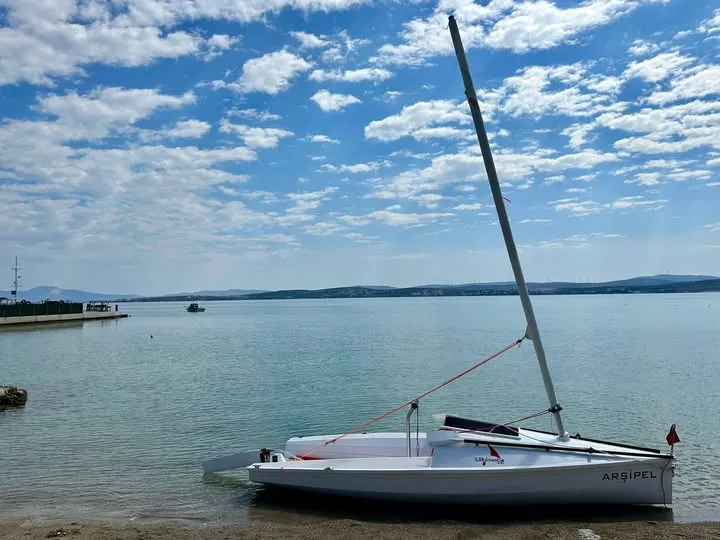
U530
Frequently Asked Questions
Distilled from the questions the designer is asked most often, plus the practical ones every buyer has.
Why does the mast have no stays or shrouds?
Because the U530 is built to launch and start sailing fast, with as little setup as possible. Bigger, heavier boats need standing rigging for much larger sail plans; the U530 doesn't. Leaving the rigging off helps on the water too: shrouds and stays add windage, and an eased sail can snag on them in a broach. An unstayed mast leaves nothing to catch and makes the sail more forgiving.
What's the point of a furling, boomless main?
Control and safety. You reduce sail by rolling it around the mast — partly or completely — pulling a single line, without leaving your seat. On a performance boat your stability depends on weight placement, so reefing without moving matters most when the wind is up. A single wrap around the mast even flattens the sail and helps it point when reefed, where a furled headsail just loses shape. And with no boom, nothing hits your head in a bad gybe, and the sail sits lower — lower heeling forces, steadier boat.
What does it cost in speed to go boomless?
About a knot dead downwind. For a boat that isn't a racer, the gains — safety, lower heeling, instant reefing — are well worth it. A light alloy boom is an option; the sail still furls with it fitted.
Will it capsize? And if it does?
It resists capsize well — the boomless rig keeps the centre of effort low — and it's self-righting. The 30 kg weighted daggerboard brings it back up; in testing it's been knocked sails-to-the-water past 60° and righted itself, and taken through a full 180° turtle and recovered. The open cockpit self-drains, and the low freeboard makes climbing back aboard easy. Built with watertight compartments, it's unsinkable — flooded, it floats.
How high does it point?
It tacks through about 90° total — roughly 45° to the wind — good for a boat of this type. As it speeds up the foils make more lift and pull it further to windward, so it points better the faster it goes.
Can it be used as a cruiser?
Yes. It's built light to surf, but for steadier displacement-speed cruising you can add ballast — 2×30 kg or 2×50 kg beside the keel case — or fit a heavier keel.
Can I fit a bigger engine than 2.5 hp?
You can, but a bigger, heavier outboard hurts sailing performance. It's designed around a small outboard (~2.3–2.5 hp), which is ample — at low throttle it'll run all day at 4–5 knots on very little fuel.
Do I need a marina?
No — that's one of the main points. At ~200 kg ready to sail, it lives on its trailer at home and is rigged and launched in about 20 minutes. The most common obstacle to owning a boat is nowhere to keep it; a spot for a trailer is enough.
How hard is it to rig and launch single-handed?
Straightforward. The unstayed 6 m mast weighs ~12 kg and is stepped or unstepped by one person in under ten minutes; the whole boat is on the water about 20 minutes after you reach the ramp.
Why is it harder (and slower) to build than ordinary boats?
It's built like a performance boat. Ordinary lay-up soaks up resin and comes out too heavy to surf; the U530 uses foam core and biaxial glass, laid up by hand with care to keep weight down and strength up. That takes experience and time, so production is limited and each boat is overseen closely.
Where is it made, and is it certified?
Designed by Bahadır Eği and built in Turkey; CE-certified to Design Category C (coastal, up to Beaufort 6 / ~27 knots, ~2 m waves).
How do I see one or try it?
Get in touch through the contact page. The best way to understand the boat is to sail it — ask about availability and what's included.
Come and sail it.
Get in touch to ask about specifications, options, and availability — or to talk through whether it's the right boat for the water you sail.