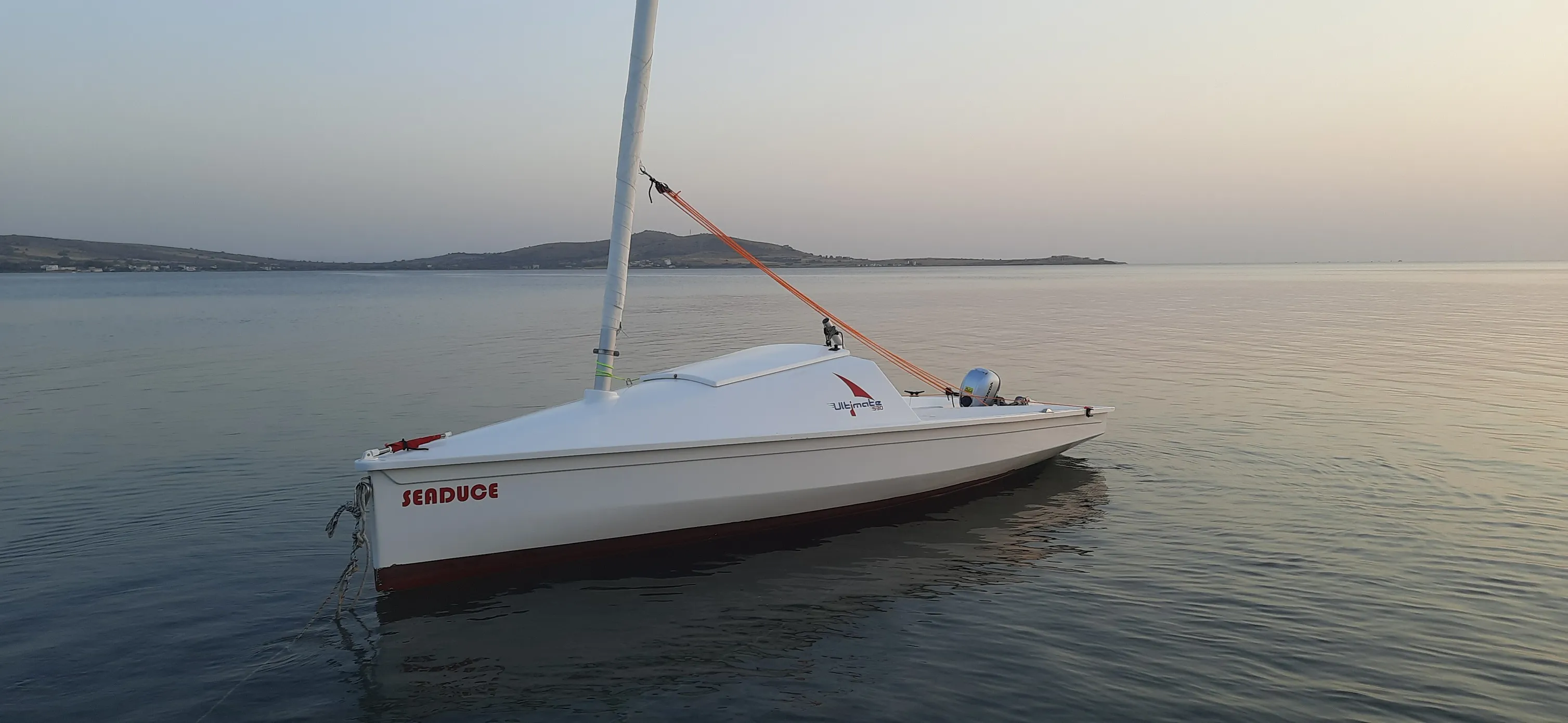
U530
The Boat
The U530 began as a simple, stubborn question: could a cabin sailboat fast enough to surf be built at a price an ordinary sailor could afford? The honest answer was that it couldn’t — not with standard methods. So it was built another way.
A hull that surfs
A boat that exceeds displacement speed and planes can’t be made from ordinary fibreglass. Standard hand lay-up soaks up resin and comes out heavy; weight is the enemy of performance. The U530’s hull is instead built from biaxial glass over a foam core — the same family of materials used in racing boats and in the European expedition boats it takes as its benchmark — laid up by hand under close supervision, ply by ply, to keep the resin low and the structure light and stiff. The result is a 5.3-metre hull of around 170 kg with a fine bow, a hard chine, and a wide, powerful stern that lifts and accelerates as the boat heels — so that on a broad reach, with the board up and no motor, it surfs into double figures. Its design ratios put it in racing-boat territory, not cruising-boat territory.
The rig: one line, no boom, no stays
This is where the U530 is most clearly its own boat. The 11 m² sail is a high-roach, full-batten main that furls around the mast. There are no shrouds or stays — the mast is unstayed — and there is no boom. To sail it, you have one sheet and a tiller. There is nothing else to trim. That choice does real work:
- Reefing is one pulled line, from where you sit. On a performance boat, stability depends on keeping your weight in the right place. Leaving your spot to wrestle a sail down costs you stability exactly when you can least afford it. Rolling the U530’s sail away — partly or completely — without moving is, in fresh wind, a safety feature as much as a convenience. A single wrap around the mast even flattens the sail and helps it point when reefed, where a furled headsail would simply lose its shape.
- No shrouds to snag. On a boat with stays, an eased sail can catch on the rigging in a broach and put you in trouble. An unstayed mast leaves nothing to catch.
- No boom to strike you. A boomless rig can’t hit your head in a bad gybe. It also sits the sail lower, which lowers the centre of effort — so the boat heels less and stays steadier. The trade is about a knot of speed dead downwind; for a boat that isn’t a racer, that’s a trade worth making.
Self-righting, by design
Under the hull is a 30 kg weighted daggerboard — a NACA-section foil, 1.35 m long, raised and lowered on a winch. Its job isn’t only to stop leeway. Its main purpose is to bring the boat back up. In testing, the U530 has been knocked flat — sails on the water, heeled past 60° — and righted itself immediately, helped by the low centre of effort of the boomless rig and the weight in the board. It has been taken through full capsize-recovery tests, including a complete 180° turtle, and recovered. The low freeboard and open cockpit make climbing back aboard straightforward, and the cockpit drains itself. A daggerboard was chosen over a centreboard deliberately: there’s no 1.5-metre slot running under the boat, nothing to maintain inside the hull, and — because there’s no centreboard case intruding into the cabin — more room below.
Unsinkable
The cockpit is open and self-draining, and the hull is divided into watertight compartments — under the cockpit, under the berth, and in the bow. Flooded, the U530 floats. It is, by construction, unsinkable.
Honest about the benchmark
We don’t hide where the idea came from. The U530’s concept draws on Europe’s best small row-and-sail expedition boats — the kind that win boat-of-the-year awards and sell for €20,000–25,000. Those boats are built with vacuum-infused cored laminate and carbon spars, and they are superb. The U530 is built from the same family of materials, but skips the vacuum-infusion step to keep the cost down. That makes it 30–40 kg heavier — so the sail was made 1 m² larger to compensate. The honest summary, in the designer’s own assessment: the U530 reaches about 90% of the performance of the boat that inspired it, at roughly a quarter of the price, and changes the formula in three ways that matter for real use — a furling sail, a daggerboard instead of a centreboard, and a price an ordinary sailor can reach. It is not a copy, and it isn’t pretending to be a carbon race boat. It’s a different answer to the same question.
Designed and built in Turkey
The U530 is the work of Bahadır Eği, a retired electrical engineer who has been designing and building small sailing boats since 1993 — earlier designs include the Sniper sailing canoe and the Nokta. It is built in Turkey and is CE-certified under the Recreational Craft Directive. It is, as far as its designer is aware, the only true domestic-designed performance sailboat built in the country.
Come and sail it.
Get in touch to ask about specifications, options, and availability — or to talk through whether it's the right boat for the water you sail.