Technical corner · 7 Sept 2022
Why a sleeved sail is so efficient
A quick tour of rig types, from the everyday to the exotic — and where the U530's mast-in-sleeve sail sits among them.
Rigs can be ranked, roughly, from least to most aerodynamically efficient.
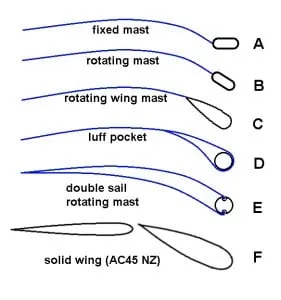
A conventional fixed mast with the sail set on a track behind it is the least efficient: the mast spoils the clean airflow, and turbulence behind it on the leeward side costs lift. That’s why such boats lean on a genoa — try sailing one under mainsail alone and you’ll feel it.
A rotating mast, as on many catamarans and trimarans, turns to present a cleaner entry on either tack. A wing mast goes further, adding its own section to the sail’s area.
The U530 takes the approach used on the Laser: the luff sleeves over the mast. There’s no step between mast and sail as the angle of attack changes, and the mast’s area becomes part of the sail’s. For a small boat it’s the simplest, most economical, and genuinely efficient choice — it makes real power without needing a headsail.
At the far end sit the wing sails of modern racing multihulls: superb, but costly, impossible to reef, and strictly for performance — no use as a cruising rig.
Come and sail it.
Get in touch to ask about specifications, options, and availability — or to talk through whether it's the right boat for the water you sail.